Introduction
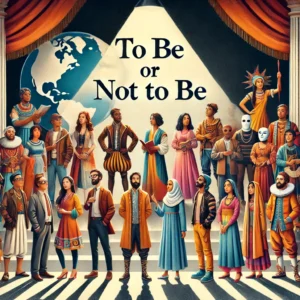
In the ever-evolving tapestry of human civilization, the concept of “To be or not to be” takes on a profound significance when viewed through the lens of a multicultural society. This famous phrase, immortalized by William Shakespeare in Hamlet, encapsulates the essence of existential contemplation. In the context of a multicultural society, it raises pertinent questions about identity, coexistence, and the challenges of navigating diverse cultural landscapes. This analytical essay seeks to explore the profound meaning of “To be or not to be” in the multicultural society, examining its implications for individual identity, societal harmony, and the pursuit of a shared humanity.
Individual Identity in a Multicultural Society
“To be or not to be” reflects Hamlet’s internal struggle with his own existence, a dilemma that resonates in the hearts of individuals navigating the intricate mosaic of a multicultural society. In a world where cultural diversity is not only celebrated but also a defining characteristic, the question of individual identity becomes both complex and fluid. People grapple with the challenge of reconciling their unique cultural heritage with the myriad influences that surround them.
In a multicultural society, individuals are not merely faced with the binary choice of “to be” or “not to be”; rather, they are confronted with the nuanced task of defining “how to be.” The kaleidoscope of cultures coexisting demands a delicate balance between preserving one’s cultural roots and embracing the diversity that surrounds. This intricate dance of identity formation unfolds against a backdrop of intercultural interactions, challenging individuals to navigate the intersectionality of their multifaceted selves.
Societal Harmony and the Struggle for Coexistence
The meaning of “To be or not to be” extends beyond the individual to encompass the broader canvas of societal harmony. In a multicultural society, the challenge is not only for individuals to grapple with their identity but also for communities to forge connections across cultural divides. The existential question posed by Hamlet resonates on a collective level as societies contemplate their shared existence amid cultural pluralism.
The quest for societal harmony in a multicultural context requires a delicate interplay of understanding, tolerance, and acceptance. The “not to be” option, in this case, represents the potential for societal disintegration fueled by cultural misunderstandings, prejudices, and ethnocentrism. Conversely, the affirmative “to be” signifies the aspiration for a cohesive and integrated society where diverse cultures coexist in a symbiotic relationship.
Navigating the Multicultural Landscape
The multicultural landscape is a dynamic terrain, and the meaning of “To be or not to be” finds resonance in the challenges and opportunities presented by this complexity. Navigating this intricate terrain involves a continuous process of adaptation, learning, and unlearning. It demands a nuanced understanding of cultural dynamics, an appreciation for differences, and a commitment to fostering inclusivity.
The phrase “To be or not to be” implies a choice, and in a multicultural society, this choice extends to how individuals and communities engage with diversity. The decision to “be” involves an active participation in the dialogue of cultures, a willingness to bridge gaps, and an openness to mutual enrichment. Conversely, the choice of “not to be” reflects a withdrawal from this dialogue, perpetuating silos of isolation and contributing to the fragmentation of the societal fabric.
Shared Humanity and the Unifying Thread
Amid the complexities of cultural diversity, the quest for a shared humanity emerges as the unifying thread woven through the meaning of “To be or not to be” in a multicultural society. While individuals grapple with their unique identities, and societies navigate the challenges of coexistence, the underlying aspiration is the recognition of our common humanity.
The choice to “be” in a multicultural society transcends cultural boundaries and embraces the shared human experience. It involves recognizing the intrinsic dignity of every individual, irrespective of cultural background, and fostering a sense of interconnectedness. In contrast, the choice of “not to be” perpetuates divisions, reinforcing the notion of ‘otherness’ and hindering the realization of a shared humanity.
Conclusion
In conclusion, the meaning of “To be or not to be” in a multicultural society encompasses a profound exploration of individual identity, societal harmony, and the pursuit of a shared humanity. The dynamic interplay of cultures presents both challenges and opportunities, demanding a thoughtful engagement with diversity. The choice to “be” involves an active participation in the dialogue of cultures, fostering inclusivity and contributing to societal harmony. On the other hand, the choice of “not to be” perpetuates isolation, hindering the realization of a shared humanity. Ultimately, the essence of “To be or not to be” in the multicultural society lies in the recognition that, despite our diverse cultural tapestry, we are all bound together by the common thread of humanity.


